Showing posts with label early chapter book. Show all posts

Saturday, 1 November 2014

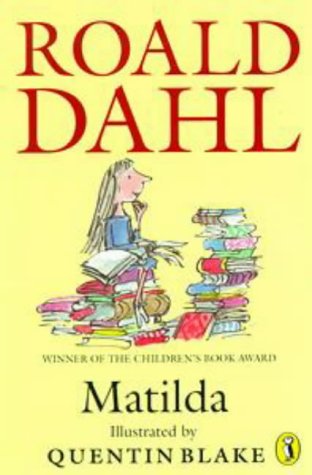
Matilda by Roald Dahl

Source: http://wordsonpaperya.blogspot.sg/
Matilda is an unusual girl. At the tender age of three, she starts reading the newspapers and by the time she is four, she is reading Great Expectations. Even geniuses do not develop such astounding reading abilities. Later, when she is in school, she also develops telekinetic powers. Sadly, her parents do not appreciate this and treat her with neglect and disdain. Fortunately for Matilda, she becomes very close to her teacher, Miss Honey, who herself is being mistreated by Miss Trunchbull. Using her telekinetic abilities, Matilda liberates Miss Honey and herself from Miss Trunchbull and her parents respectively and Matilda moves in to live with Miss Honey.

Many young readers will be delighted and thoroughly entertained by how reading gives Matilda superpowers. Roald Dahl used this story to depict reading as a highly desirable activity that is magical and empowering. Being a strong protagonist throughout the story, many children will look up to Matilda and thus be encouraged to read widely. Some titles of the books she reads are even mentioned.

This story has a very clear theme of good vs evil. Not only is the theme clear, the distinction between the good characters and the evil characters is very obvious. Some parents have expressed their concern that in Roald Dahl's books, children are always portrayed as good characters and adults always depicted to be bad. This is indeed a distinctive trait of many of Roald Dahl's books and Matilda is no different. The heroine of the story, Matilda, is a young girl and the antagonists, her parents and Miss Trunchbull, are adults. However, this book has a slight exception. Miss Honey is an adult but good and is also mistreated by the "evil" characters. Mrs Phelps, the librarian, also treats Matilda well.

This book also attempts to convey a subtle message to parents that children should be allowed to explore and discover their own hobbies. For instance, Matilda's parents should not keep insisting that she should watch television just because it is something they like to do. This can help offer a slight glimmer of hope to children who have parents who are not supportive of their hobbies or interests of choice. Maybe like Matilda, they will meet their Miss Honey one day.

Reading this book again as an adult, I found it very unrealistic and idealistic. However, children do need a bit of magic in their stories and this story has been enjoyed by many over the years. It even has movie and musical adaptations which have also been very well received.

Wednesday, 29 October 2014

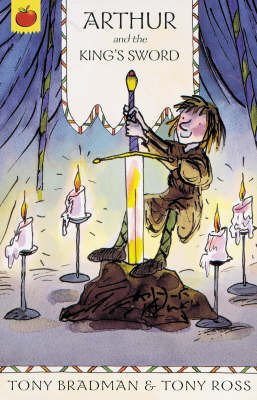
Arthur and the King's Sword by Tony Bradman & Tony Ross

Source: http://childrensbookshop.circlesoft.net/
This is a book for early readers and tells the famous tale of how Arthur, a mere squire, becomes king. When his brother, Kay, loses his sword, Arthur scrambles to find him a new one. His search leads him to the legendary Excalibur. After discovering that he is the only one able to pull it from the stone and yield its power, Arthur is made King of Britain.

This is a famous legend told in a way that captures the attention of young children. It is narrated as a classic adventure tale and has a simple linear plot, making it easy for young readers to understand and read independently. As with many legends, this story follows the monomyth, or the hero's journey, and as expected, the hero triumphs at the end.

What makes this story even more endearing is that the hero, Arthur, is seen as the underdog throughout. Hence, children will tend to empathise with Arthur more and celebrate his eventual victory.

There are many illustrations that accompany the text in this book. Although they are in black and white, they complement the story well and help to hold the attention of young readers. Being a simple chapter book, the illustrations can help children make the transition from picture books to chapter books. They also help to make reading less intimidating for new or reluctant readers. The language used is also simple most of the time but contains some challenging words like "amazement" and "summoned". This will encourage readers to learn new words and expand their vocabulary.

This book would be recommended for children between the age of 6 and 9. Reading this simple and enchanting version of this well-loved legend is a fantastic way to introduce children to historical fiction. As this genre has material written for every age group, there is a high chance of fostering lifelong reading habits among children who enjoy this genre.

Just considering the legend of King Arthur alone, there are books written for a diverse audience.

For older children/young teens: King Arthur and His Knights of the Round Table by Roger Lancelyn Green
Source: https://www.goodreads.com
For young adults: King Arthur: Dragon's Child by M.K. Hume
Source: https://www.goodreads.com
For adults: The Winter King by Bernard Cornwell
Source: https://www.goodreads.com