Showing posts with label older readers. Show all posts

Tuesday, 28 October 2014

Rose Blanche by Roberto Innocenti & Ian McEwan

Source: www.ianmcewan.com
This book tells of war and holocaust during World War II through Rose Blanche's perspective and readers get a peek into the real and honest observations of a young girl in Germany during the war.

In the beginning, we see how Rose Blanche views the war in a naive and innocent manner. This is especially so since the war did not change her life much. She still continued to go to school, play with her friends and walk around town safely. One day, she sees a little boy trying to escape from a lorry. Curious, she follows the lorry and finds herself outside a camp of prisoners. Seeing the sad and hungry prisoners, she goes back to the camp regularly to bring them food. However, the tides of war soon turn and the people in her town are forced to leave. Rose Blanche decides to make one more visit to the camp but is never seen after that.

This story uses simple language and is complemented by strong impactful illustrations. Although not explicitly stated, readers can tell from the yellow star on their uniforms that the prisoners whom Rose Blanche encountered were Jews who have been captured by the Nazis.
Source: thechildrenswar.blogspot.com
Rose Blanche's death is also not explicitly depicted either through text or illustrations. All readers are told is that "As Rose Blanche turned to walk away, there was a shot, a sharp and terrible sound which echoed against the bare trees." At this point, the narration of the story switches from her point of view to a third person one. We are also told that her mother never finds her after the day the town is evacuated. Through this, readers learn that she is accidentally shot and her love and kindness was only known by the few prisoners she managed to help.

Rose Blanche demonstrates the kind of compassion a young girl is capable of. Although she does not fully understand the significance of the hungry and miserable looking prisoners, she continues to return to the camp to bring them food. This book also shows the impact of war and how lives are inevitably changed. Initially, Rose Blanche's life goes on as usual. We see that the only difference the people in the town seem to experience is the shortage of food. However, later in the story, everyone has to evacuate and eventually another foreign army enters the town.

It is also interesting to note that the name Rose Blanche is a reference to a German resistance group called "The White Rose" which attempted to warn Germany of the dangers of Hitler's national campaigns. This story uses Rose Blanche, a girl who goes out of her way to help the Jewish prisoners in whatever small ways she can, as a symbol of resistance to the Nazi regime.

Rose Blanche is a powerful book that appeals to a very wide range of audience. Its simple language makes it easy for younger readers to read and understand. They will also enjoy the detailed and moving illustrations. As it is also brimming with inferred meanings and symbolism, it is sure to pique the interest of older readers too.

Saturday, 25 October 2014

The Wall by Peter Sis

Source: http://picturebooks4olderreaders.wordpress.com/
The Wall: Growing Up Behind the Iron Curtain illustrates life under Communist rule from the perspective of the author as a child who loved to draw. The story starts off in his young days where he was convinced of everything he was told. This was also when he developed his love for drawing. However, during his adolescence, he starts to question the oppressive nature of the government and gradually starts dreaming of being free of communist rule. At the end of the book, we see his dream being realised with the end of the Cold War and the Berlin Wall torn down.

The poignant illustrations in this book offer some interesting points for discussions. One that was particularly impactful was a "map" with words describing life on either sides of the wall.
Source: photo taken by me
On the side under communist rule, the landscape is barren with adjectives like "injustice", "corruption" and terror". On the other side, the landscape is given a warm orange colour and words like "freedom", "benevolence" and "equality" are used to describe the life and people there. This can help to educate students on how freedom and justice should not be taken for granted.

This book consists of two simultaneous storylines. One tells of the historical events from the point of view of the author. This narrative also portrays oppressive nature of communism. The second storyline is more of a personal account of the author where he expresses his love for art and desire to be free from an oppressive government.

Although this is a picture book with simple language, it is more suited for older readers. Having two stories told concurrently makes it a more complex book which younger readers might not understand and appreciate. In addition, this book also offers an accessible and lighthearted way to introduce young students to political issues such as communism.

Thursday, 23 October 2014

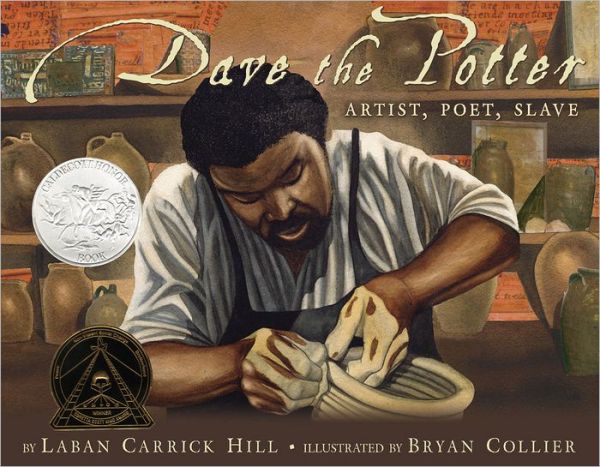
Dave the Potter - Written by Laban Carrick Hill & Illustrated by Bryan Collier

Source:http://www.barnesandnoble.com/
Dave the Potter is a beautiful picture book which tells the story of Dave, an African American slave. It is a heartwarming tale of how despite being enslaved, Dave still had the chance to flourish as an craftsman by being trained as a potter. This book is written in a very poetic style accompanied by detailed watercolour illustrations.

Laban Carrick Hill starts off the story by highlighting the difference between Dave and other people. This is done by contrasting how things (e.g., dirt) are perceived to us against what they mean to Dave. In addition, readers are given an insight into Dave's expertise as a potter and how it makes him special. Pottery is a specialised skill and even though Dave is a slave, he is highly skilled.

Bryan Collier's illustrations also help to demonstrate the amount of hard work and dedication Dave puts into his craft. By having each stanza accompanied by a painting, readers are able follow Dave every step of the way as he creates a piece of pottery.

Source: http://kathyellendavis.com/
What makes Dave special as a potter is that he leaves little bits of poetry on his jars and pots. Some of his original writings are also included at the end of the book. Reading these provides greater insights into Dave's life and enables the reader to go through the book with greater understanding and empathy.

This book does an excellent job in telling readers about slavery without any negativity that sometimes accompanies the topic. It is a story of an empowered slave as even though he is a slave, Dave has the means to cultivate his craft. Hence, reading this picture book is great way to ease into the topic of slavery, especially with young readers.

Friday, 5 September 2014

Belonging by Jeannie Baker

Source: http://www.jeanniebaker.com/
Belonging is a wordless picture book which follows the life of Tracy through the view from her window. Through the illustrations on each page, we see the growth of Tracy from a little girl to a woman. She is usually seen in the garden through the window and personal items on her windowsill help to portray which phase of life she is going through.

Through her window, we also get the see the neighbourhood she grows up in and its progress over the years. We see how the residents of the neighbourhood take charge of the street they live in, changing it from an industrialised landscape full of concrete buildings to a place full of lush vegetation.

When Tracy is just a newborn baby, the garden of their home looks dry and does not have any plants. The surrounding buildings are run down with graffiti on the walls and in the distance, all we see is a concrete jungle. Not many people are seen along the streets as well.

Source: http://gatheringbooks.org/2011/04/12/home-window-jeanniebaker/
Amid this heavily industrialised urban landscape, Tracy's neighbour can be seen planting a small plant in his garden. His garden flourishes over the years and when Tracy is 6 years old, he gives her a plant. This could have had a life-changing impact on Tracy as in the subsequent years, we see her cultivating her garden which continues to blossom.
Source: http://www.jeanniebaker.com/
Over the years, we also see Tracy's neighbour actively trying to change the landscape. When Tracy is 8 years old, he plants a tree in the public area opposite her house. 2 years later, he participates in a "Reclaim Your Street" campaign. By this time, many people have started spending time outdoors interacting with one another. We see other residents starting to play a more active role as well with more people planting plants and the street is transformed into a communal recreational area.
Source: http://www.adelle.com.au
When Tracy turns 16, plants have even been planted along the main street and a park has opened in the distance. By the time she gets married at 22, the whole neighbourhood is teeming with vegetation. Finally, we see Tracy having a baby of her own and by then, the plants in the neighbourhood has become such an integral part of the lives of its residents.
Source: http://gatheringbooks.org/2011/04/12/home-window-jeanniebaker/
This book subtly drives a powerful message that development and industralisation often harms the land we live in. As people living in this land, we must take the responsibility to restore it. Jeannie Barker portrays how a community can make a huge positive impact on their neighbourhood by being actively involved in bringing about change. We also see how an individual's efforts can influence a community by seeing how Tracy's neighbour, by giving Tracy a plant and planting a tree in a public space triggered a change in Tracy as well as the other residents in the neighbourhood.

In this book, each page is a collage which Jeannie Baker has done using real plants. This is particularly heartwarming as in this era filled with computer-aided graphic design, Jeannie Baker proves that there is still a place for the more traditional art forms. With the use of natural textures, she creates wonderful works of art which continues to touch the hearts of readers.