Showing posts with label younger readers. Show all posts

Friday, 31 October 2014

The Jolly Pocket Postman by Janet & Allan Ahlberg

Source: http://www.unclephilsbooks.co.uk
The Jolly Pocket Postman is an amazingly fun and interactive picture book that will definitely bring lots of fun and laughter to young children. This book follows the Jolly Postman as he makes his rounds delivering mail. He soon finds himself delivering mail to many familiar characters as well. Many of these characters are famous personalities in the world of children's fiction like the Mad Hatter and Dorothy.

This book is beautifully illustrated. It has a great combination of art and interactive pages which provides wonderful a reading experience. The most outstanding characteristic of this book is that there are envelopes every few pages that children can open and be surprised with whatever they contain. Each mail item is also unique and some have little tales of their own. With such delightful elements, they will certainly be reading this book with a sense of wonder.
Source: photo taken by me
Children will also be introduced to fairytale characters while accompanying the Jolly Postman on his journey. The Jolly Postman not only delivers mail to different fairytale characters, he also encounters them in the setting of their fairytale. Children reading this book will be able to recognise them from other stories they have read or been told and this provides yet another element of fun!

Although young children will probably not be able to understand them, this book has several witty puns and wordplay cleverly incorporated. For example, this is a circular.
Source: photo taken by me
I think this book is especially precious since today, the use of snail mail has reduced a lot. As people are mostly communicating electronically now, many children might grow up not knowing what it is like to receive a letter or card in the mail. Although this book cannot exactly replicate that experience, it can at least give children a small taste of it.

This book will definitely be enjoyed by children of all ages. Some words are quite challenging but younger children can still have a lot of fun with the interactive mail items while being read to.

Every child will also most certainly need a map of fairytale land.
Source: photo taken by me

Wednesday, 29 October 2014

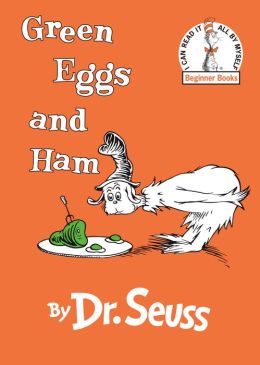
Green Eggs and Ham by Dr Seuss

Source: www.barnesandnoble.com
The story of Green Eggs and Ham is a simple one. Sam-I-am pesters the narrator to try his dish of green eggs and ham. The narrator refuses and responds by saying "I do not like them, Sam-I-am. I do not like green eggs and ham." He continuously repeats this as Sam badgers him to get him to try the dish in various locations and with different animals. The narrator finally relents and eats the green eggs and ham. He discovers that he actually likes them and ends by declaring "I do so like green eggs and ham! Thank you! Thank you, Sam-I-am!"

As with most of Dr Seuss' works, Green Eggs and Ham is a fun and delightful read filled with rhyme, rhythm and repetition. Almost the entire book is written in the form of a rhyming couplet.
Source: photo taken by me
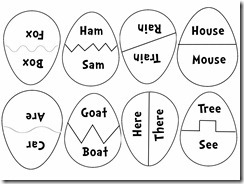
The use of such a predictable rhyming scheme not only makes it fun for children to read aloud, it also provides the opportunity to learn the concept of rhyming words. There are even games and activities using the words in the book to help children identify the rhyming words. One such example is shown below.

Source: www.obseussed.com
This book only contains fifty different words and a large portion of them are repeated. This repetition helps create a long-lasting impression of rhyming words. It will also help reinforce new words as they are encountered again and again.

This story encourages children to have a sense of adventure and not to fear uncertainty. The green eggs and ham which Sam offers the narrator is seen as something new and unknown. The narrator is initially resistant to trying it but after he does, he realises that he likes it. This encourages children to always give something a try before deciding if they like or dislike it. Reading this as a young child, I remember thinking that the narrator has wasted so much of his time resisting something he could have enjoyed much earlier!

The whimsical illustrations that are highly characteristic of Dr Seuss also adds on to the sense of imagination and adventure this book provides.
Source: photo taken by me
Dr Seuss is undeniably one of the most classic and iconic writers of children's books. His books have the magical ability to transcend time and continue to touch and entertain children decades later. Although first published in 1960, Green Eggs and Ham is still enjoyed by children around the world today. Dr Seuss' works have also greatly influenced popular culture with books like "The Cat in the Hat" and "The Lorax" being adapted into movies. There is also a Dr Seuss themed section in Universal's Islands of Adventure called Seuss Landing.
Source: http://en.wikipedia.org/

Wednesday, 10 September 2014

The Paper Bag Princess - Written by Robert Munsch & Illustrated by Michael Martchenko

Source: http://childrensbooksguide.com/classics/the-paper-bag-princess
The Paper Bag Princess introduces readers to a delightful twist to the classic princess fairy tale. The story starts off like many other fairy tales - the beautiful Princess Elizabeth is going to marry a prince whom she loves very much. However, this is where the similarities stop. Elizabeth's castle is attacked by a dragon and this time it is Prince Roland who gets kidnapped. As all her clothes have been destroyed, Elizabeth puts on paper bag and bravely goes off to save her prince. She hunts the dragon down and outsmarts him into exhaustion. When Prince Roland sees her, however, he tells her that she does not look like a princess and asks her to come back when she is dressed like one. In response, Elizabeth calls him a bum and decides not to marry him after all.

What makes this book special is the way it challenges social norms and gender stereotypes. Instead of the princess being the damsel in distress being rescued by her knight in shining armour, this story shows that the princess can be the one saving her prince too. By following the adventures of a heroine wearing just a paper bag, little girls will also see that they do not have to look pretty all the time.

Another interesting point in this story is how Princess Elizabeth defeats the dragon. Without physically harming the dragon in any way, Princess Elizabeth cleverly tricks the dragon into tiring itself out. This exposes young children to the idea that wit is stronger than brute force and that violence is not necessary to save the day.

The illustrations help to bring out the narration of the story. Each page is accompanied by an illustration portraying the emotions and actions of the character at each point in the story. Princess Elizabeth is illustrated with singed hair and a charred and dented crown. This further enhances the idea that she is a brave and intelligent heroine regardless of how she looks.

This book is an enjoyable read despite not being written in a rhythmic way. It also provides a fun and easy way to start children thinking and discussing about gender roles and the perception of beauty. Many children will also love the humourous way the story is told which will make for an engaging read.

Friday, 5 September 2014

The Gobbling Tree - Written by Mark Carthew & Illustrated by Susy Boyer

Many children who love to play outdoors have had their ball or some other toy stuck in a tree. In The Gobbling Tree, Mark Carthew tells us about a tree that won't give them back!
Source: http://www.newfrontier.com.au/
Zac is out playing cricket one day and his ball gets stuck in a tree. Soon, all his friends come to help Zac by using their own belongings to get his ball back. However, the tree gobbles all their stuff up and soon all of them have something of theirs stuck in the tree - even his friend Simon climbs up into the tree and gets stuck! Fortunately, everything eventually gets blown down by the wind. We see that Zac has not learnt his lesson, though. At the end of the book, Zac is out playing cricket again and once again, his red ball has found its way into the tree.

This book is full of rhyme and rhythm which helps make reading aloud to children fun. The use of sound effect words and exclamations also help to add to the excitement of the story. This story also fosters imagination and a sense of adventure. Mark Carthew personifies a tree and takes a regular, everyday occurrence and turns it into a fun-filled story.

Susy Boyer's use of bright vivid colours helps to further capture the attention of children. Her illustrations compliments the narrative well and helps in storytelling. By giving the tree a huge smiley face, young readers are further encouraged to imagine the tree to be a greedy and mischievous creature who gobbles up anything that comes its way. Zac and the other characters also have rather exaggerated expressions and this can help children to relate to the characters' emotions and empathise with them.

This book's catchy rhyming narrative coupled with its bright and cheery illustrations makes it an excellent book to read to a small group of young children. Parents or teachers can easily turn it into a fun and interactive storytelling experience.

Watch Jimmy Giggle reading the book here!