Tuesday, 28 October 2014

Rose Blanche by Roberto Innocenti & Ian McEwan

Source: www.ianmcewan.com
This book tells of war and holocaust during World War II through Rose Blanche's perspective and readers get a peek into the real and honest observations of a young girl in Germany during the war.

In the beginning, we see how Rose Blanche views the war in a naive and innocent manner. This is especially so since the war did not change her life much. She still continued to go to school, play with her friends and walk around town safely. One day, she sees a little boy trying to escape from a lorry. Curious, she follows the lorry and finds herself outside a camp of prisoners. Seeing the sad and hungry prisoners, she goes back to the camp regularly to bring them food. However, the tides of war soon turn and the people in her town are forced to leave. Rose Blanche decides to make one more visit to the camp but is never seen after that.

This story uses simple language and is complemented by strong impactful illustrations. Although not explicitly stated, readers can tell from the yellow star on their uniforms that the prisoners whom Rose Blanche encountered were Jews who have been captured by the Nazis.
Source: thechildrenswar.blogspot.com
Rose Blanche's death is also not explicitly depicted either through text or illustrations. All readers are told is that "As Rose Blanche turned to walk away, there was a shot, a sharp and terrible sound which echoed against the bare trees." At this point, the narration of the story switches from her point of view to a third person one. We are also told that her mother never finds her after the day the town is evacuated. Through this, readers learn that she is accidentally shot and her love and kindness was only known by the few prisoners she managed to help.

Rose Blanche demonstrates the kind of compassion a young girl is capable of. Although she does not fully understand the significance of the hungry and miserable looking prisoners, she continues to return to the camp to bring them food. This book also shows the impact of war and how lives are inevitably changed. Initially, Rose Blanche's life goes on as usual. We see that the only difference the people in the town seem to experience is the shortage of food. However, later in the story, everyone has to evacuate and eventually another foreign army enters the town.

It is also interesting to note that the name Rose Blanche is a reference to a German resistance group called "The White Rose" which attempted to warn Germany of the dangers of Hitler's national campaigns. This story uses Rose Blanche, a girl who goes out of her way to help the Jewish prisoners in whatever small ways she can, as a symbol of resistance to the Nazi regime.

Rose Blanche is a powerful book that appeals to a very wide range of audience. Its simple language makes it easy for younger readers to read and understand. They will also enjoy the detailed and moving illustrations. As it is also brimming with inferred meanings and symbolism, it is sure to pique the interest of older readers too.

Monday, 27 October 2014

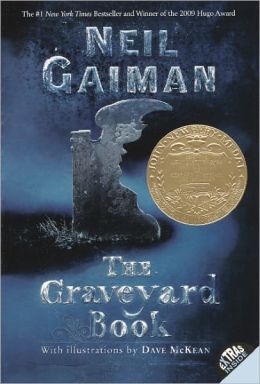
The Graveyard Book by Neil Gaiman

Source: www.barnesandnoble.com
The Graveyard Book is a retelling of Rudyard Kipling's The Jungle Book but set in a graveyard instead. Having escaped the murder who killed his family, Nobody "Bod" Owens seeks shelter in a disused graveyard and is brought up and sheltered by the community of the dead. He is given the "Freedom of the Graveyard", allowing him to learn ghost tricks including the ability to appear invisible when someone is looking at him. This book follows Bod's experiences and adventures growing up in the graveyard and the delightful array of characters who help bring him up. We also see his attempt at making friends with a human girl, Scarlett. At the end of the story, Bod also discovers why his family was killed and why he is being hunted.

The Graveyard Book is a highly imaginative, exhilarating fantasy adventure and is told captivatingly. Neil Gaiman is a lively and dramatic storyteller who is sure to enchant readers of all ages. Readers who are interested in the supernatural will be especially delighted as vampires, ghouls and other spirits of the dead run rampant in this story.

The classic good vs evil theme has also been given a fun twist here. Mummies and vampires who are traditionally given evil roles are portrayed as good characters while the villains are human. Many characters are also not clearly good or evil but face choices which will lead them to be either.

An interesting question for children to ponder while reading this book is: how can the dead raise a human boy? Bod faces the question of identity since is not dead yet he has no experience interacting with the living. Even though Bod is a living human being, the community in the graveyard take good care of him and we see their undying (pun intended) love for Bod throughout the story. The coming-of-age theme makes an appearance in this book as well and can be seen when it is time for Bod to leave the graveyard, which he has come to associate with the safety and comfort of home. We see him leaving with a sense of uncertainty. Is he prepared for the real world? Can he assimilate into the society of the living?

This book is not only great for young adults but also a good book for parents and educators to read aloud to younger children. Children who have enjoyed this book should also be encouraged to read Rudyard Kipling's The Jungle Book.

Saturday, 25 October 2014

The Wall by Peter Sis

Source: http://picturebooks4olderreaders.wordpress.com/
The Wall: Growing Up Behind the Iron Curtain illustrates life under Communist rule from the perspective of the author as a child who loved to draw. The story starts off in his young days where he was convinced of everything he was told. This was also when he developed his love for drawing. However, during his adolescence, he starts to question the oppressive nature of the government and gradually starts dreaming of being free of communist rule. At the end of the book, we see his dream being realised with the end of the Cold War and the Berlin Wall torn down.

The poignant illustrations in this book offer some interesting points for discussions. One that was particularly impactful was a "map" with words describing life on either sides of the wall.
Source: photo taken by me
On the side under communist rule, the landscape is barren with adjectives like "injustice", "corruption" and terror". On the other side, the landscape is given a warm orange colour and words like "freedom", "benevolence" and "equality" are used to describe the life and people there. This can help to educate students on how freedom and justice should not be taken for granted.

This book consists of two simultaneous storylines. One tells of the historical events from the point of view of the author. This narrative also portrays oppressive nature of communism. The second storyline is more of a personal account of the author where he expresses his love for art and desire to be free from an oppressive government.

Although this is a picture book with simple language, it is more suited for older readers. Having two stories told concurrently makes it a more complex book which younger readers might not understand and appreciate. In addition, this book also offers an accessible and lighthearted way to introduce young students to political issues such as communism.

Friday, 24 October 2014

Magician: Apprentice (Graphic Novel) by Raymond E Feist

Source: http://www.crydee.com/
Magician: Apprentice is a graphic novel adaptation of a fantasy novel of the same title.
Source: http://www.crydee.com/
Set in the fictional kingdom of Midkemia, this story tells of the adventures of two young kitchen boys, Pug and Tomas. One fateful day, Pug discovers an alien ship wrecked along the shore. Anticipating an invasion from this alien race, Pug and Tomas find themselves part of a convoy, travelling to the capital of Midkemia to warn the king. However, their party is attacked along the way and this is just the beginning of a long, eventful and swashbuckling adventure.

Amid the plethora of superhero stories, Magician: Apprentice offers something different to graphic novel fans. Being a graphic novel adaptation of a fantasy novel, Magician: Apprentice contains all the traditional elements of a high fantasy tale. Fast paced and action packed, readers will be taken on an adventurous journey that is sure to keep them hooked.

Although part of an epic fantasy saga, Magician: Apprentice does not have an overly complicated plot. Hence, it makes for an excellent read for young adults and even for readers in their early teens. The characters are varied, strong and well-developed and readers can very easily relate to them. Having two young teenage boys, Pug and Tomas, as protagonists, this graphic novel does feature several coming of age themes that are close to the heart of many teenagers. Most significantly, we see how Pug and Tomas try to find their place in society as they take up their respective apprenticeships (Tomas as a soldier and Pug as a magician).

Reading this story as a graphic novel is a great way to introduce the fantasy genre to reluctant readers. It is also a fantastic and lighthearted way to expose young teens to new ideas and concepts. As it is set in a primary world that does not exist in reality, readers can be encouraged to explore worldbuilding, thus fostering creativity. In addition, although Midkemia is ruled by a monarchy, this story contains many political intricacies which can spark an interest in politics in young readers.

Thursday, 23 October 2014

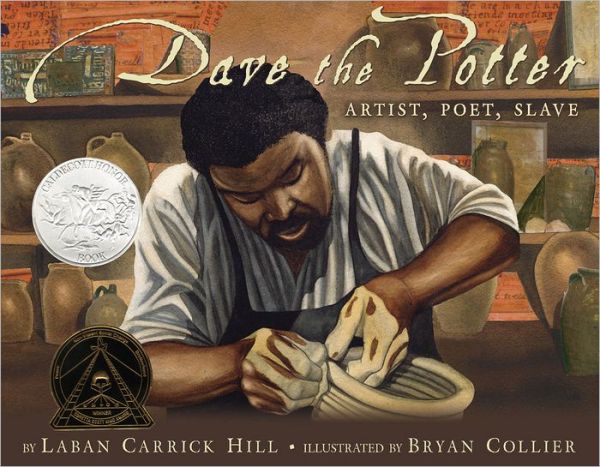
Dave the Potter - Written by Laban Carrick Hill & Illustrated by Bryan Collier

Source:http://www.barnesandnoble.com/
Dave the Potter is a beautiful picture book which tells the story of Dave, an African American slave. It is a heartwarming tale of how despite being enslaved, Dave still had the chance to flourish as an craftsman by being trained as a potter. This book is written in a very poetic style accompanied by detailed watercolour illustrations.

Laban Carrick Hill starts off the story by highlighting the difference between Dave and other people. This is done by contrasting how things (e.g., dirt) are perceived to us against what they mean to Dave. In addition, readers are given an insight into Dave's expertise as a potter and how it makes him special. Pottery is a specialised skill and even though Dave is a slave, he is highly skilled.

Bryan Collier's illustrations also help to demonstrate the amount of hard work and dedication Dave puts into his craft. By having each stanza accompanied by a painting, readers are able follow Dave every step of the way as he creates a piece of pottery.

Source: http://kathyellendavis.com/
What makes Dave special as a potter is that he leaves little bits of poetry on his jars and pots. Some of his original writings are also included at the end of the book. Reading these provides greater insights into Dave's life and enables the reader to go through the book with greater understanding and empathy.

This book does an excellent job in telling readers about slavery without any negativity that sometimes accompanies the topic. It is a story of an empowered slave as even though he is a slave, Dave has the means to cultivate his craft. Hence, reading this picture book is great way to ease into the topic of slavery, especially with young readers.

Monday, 6 October 2014

All I Ever Wanted by Vikki Wakefield

Source: http://vikkiwakefield.com
Mim, a teenage girl who is turning 17, has been brought up by a single mother and two brothers who are drug dealers. However, she has very firmly made up her mind that she will not turn out like her mother. Hence, she proceeds to set a list of rules for herself to live by. "I will finish school. I will not take drugs..." the list goes on and on. One day, her mother sends her on an errand to pick up a dubious package. Unfortunately, it gets stolen on her way home and consequently, her life starts to unravel and she starts breaking those rules one by one.

Although many teenagers would not have grown up in the same circumstances at Mim, the experiences and emotions she goes though are things that most teenagers would be able to relate to. Friendships, romance, peer pressure, dreams and aspirations are just a few issues Mim constantly contends with just like any other teenager anywhere else in the world.

Like many teenagers, Mim feels misunderstood and that she does not fit in. However, instead of succumbing to peer pressure, she strives to be "better" than her mother and her family by setting a list of rules for herself which she works hard to adhere to. This causes her to alienate herself from her family and friends and even to fall out with her best friend.

Teenagers also tend to feel that the world is against them. Mim is no different. She feels that her current situation that she has been forced into by being born into a dysfunctional family is holding her back from having a bright future. By the end of the book however, she realises that she has misjudged many of the people in her life, especially her mother. The package which her mothers asks her to pick up at the beginning of the story turns out to be documents for an exchange programme in France and not drugs like what Mim thinks it is. This shows that contrary to what Mim thinks, her mother actually understands her very well and knows how much she desires to get away from her hometown and to see the world.

With a heartwarming yet gritty and honest story and authentic characters, All I Ever Wanted is definitely a book which many teenagers will be able to relate to. It also encourages them not to be so quick to dismiss the care and concern from their family and friends just because they are under the impression that they do not understand them. This is undeniably a highly recommended coming of age book which will resonate with many teenagers.

Friday, 3 October 2014

Gone Case by Dave Chua

Source: www.goodreads.com

Gone Case is narrated by a 12-year-old boy named Yong. Being a typical Singaporean boy, he tells of his everyday experiences of growing up in a Housing Development Board (HDB) estate and the challenges he faces in school while preparing for his Primary School Leaving Examination (PSLE). We also get a peek into his family life as he comes to terms with the death of his grandmother and how his parents' financial difficulties affect his family.

Growing up in Singapore in the 1990's, reading this book was like a trip down memory lane. Using vivid descriptions, Dave Chua provides an honest and real picture of what a typical HDB housing estate in Singapore was like. The heavy use of Singlish in the dialogues also adds to its authenticity. Many issues Yong deals with as a 12-year-old also resonates with many Singaporeans, especially those of the same generation. Preparing for his PSLE, being a prefect in school and the upgrading of the playground in his neighbourhood are just a few striking examples. What I related to the most was how many students viewed the education system then.
"I feel like a liar, a fraud, that all my knowledge is false and that I really do not know anything at all. But this is the way to study. If I do not understand something I read and read and do it until I could do the problem through a method, never really comprehending but able to look like I know, enough to get some marks on a question."
This very clearly echoes the thoughts of many students and educators then and was often a topic for discussion.

Besides issues that are distinctly Singaporean, Yong also experiences many things that are common to any adolescent regardless of country. He constantly struggles to strike a balance between peer pressure and his parents' expectations of him. He also nurses a crush on his best friend's sister. These are common concerns that are part and parcel of growing up and anyone would be able to relate to them.

While Gone Case is a very descriptive book with a very atmospheric and slightly melodramatic feel, it does not draw readers in with a strong and gripping plot. For the most part, we see the protagonist, Yong, merely recounting his experiences and observations. He seems largely disengaged and does not play a significant role in driving the plot. Hence, young readers who are after fast-paced and exciting plots may grow disinterested quickly.